Near miss (hit?) with FPV R/C model?

Itchy

Well-Known Member
http://www.huffingtonpost.com/2012/...id10|htmlws-main-bb|dl4|sec3_lnk1&pLid=161623

One relatively new facet of model flying is First Person Video flying, where you wear vision goggles and can fly a model up to 30+ miles away. Some of these folks are getting up to 11K in altitude too. It is nuts, some of the videos posted in the forums for that sport are both amazing, but also, careless. The prevailing attitude is small airplane big sky, no problem.

Some of the insanity can be seen here:
http://www.rcgroups.com/forums/showthread.php?t=1351677

Sooner or later there will be a problem. One video showed a guy at 11K feet 60 west of IAD.
 
A red balloon went by at ~12k over the Palm Springs area today. We were going about 340 knots and it scared me. I may be incorrect but anything above 10k requires a transponder. They may not know how much trouble they can get it.

I enjoy RC and it is not regulated in any real way. It would be sad to see that change because of ignorance or just stupidity.
 
It was TERRORISTS I TELL YA! I'm calling the TSA now and recommending body cavity searches for anyone with RC equipment purchasing histories, just to be safe.
 
I can't remember where I read it now, but I think I there was a letter from the FAA that basically stated they weren't concerned about anything that weighs less than four pounds and had a density less than ... something per cubic inch (somewhere between denser than expanded styrofoam, but less than LDPE) ... basically bird-sized stuff.

Whether people are actually adhering to that guidance, I dunno. Given the current state of readily-available technology I think that's generally true. I dunno how those iPhone-on-a-weather balloon things work out. I'm skeptical that packing the phone in a big brick of styrofoam would continue to meet the average density guideline when it encounters a windshield.
 
The ones that are making significant range have a pretty serious battery in them which would be pretty dense. Maybe about the size of three tv remotes stacked together and over a pound in weight.

Who knows? Maybe a collision would never happen. I know this all came to a head a little while ago with the FAA, and the rules were something like 400' max altitude and model in line of sight at all times. But I know many (MOST) in the FPV community completely ignore that. I doubt any of them would show up on a civilian ATC radar.

The technology to do it is mind boggling, and relatively cheap. The display to the pilot flying it is not unlike a G1000, heading,altitude, fuel (battery capacity), attitude, yada yada. With full visual in the background instead of synthetic vision.

Here is one hitting 16K + feet!


And another going out 10 miles....
xhttp://vimeo.com/23774500
You will have to copy and paste, and remove the x in front of the url.
 
I can't remember where I read it now, but I think I there was a letter from the FAA that basically stated they weren't concerned about anything that weighs less than four pounds and had a density less than ... something per cubic inch (somewhere between denser than expanded styrofoam, but less than LDPE) ... basically bird-sized stuff.

How did that work out for NASA? Oh, its only foam, what's the worst that could happen?
 
There is some sort of 200MPH speed limit from the AMA (Academy of Model Aeronautics) in the USA, but who governs that? I would think that with the size and speed of these things, it wouldn't be an easy thing to spot.
 
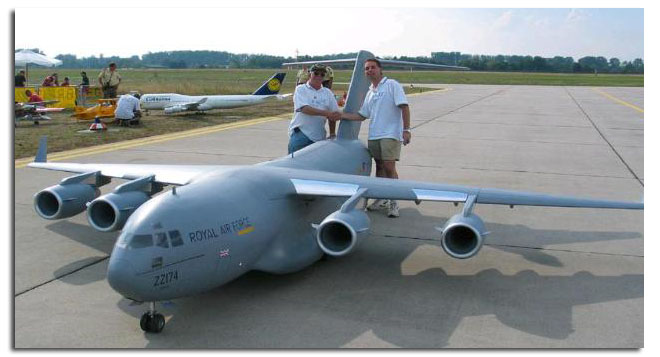
When I flew RC the largest models were 144" wingspan and so few people owned them as at that time they cost about the same as a C-150. Now it seems that they have increased in speed, size, etc.

RC-2.jpg


giant-scale-rc-airplanes5.jpg
 
Back
Top